The Absurd and the Unexplainable Everyday
The NoseThe Absurd and the Unexplainable Everyday is the organizing principle of “The Nose,” in which an impossible bodily separation unfolds amid breakfast, shaving, public appearances, and the ordinary rhythms of city life. Rather than supplying a supernatural rule or a rational solution, the narrative places the inexplicable directly inside the familiar and lets routine continue around it. Its comic force comes not only from the extraordinary events, but from the characters’ attempts to treat them as practical problems—and from the narrator’s eventual admission that no adequate explanation is available.
The Impossible Enters the Routine
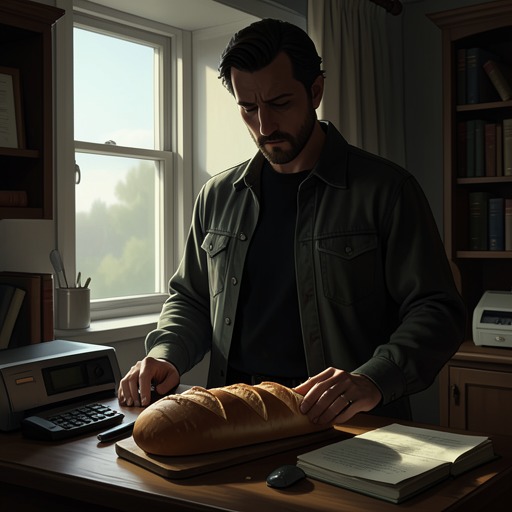
The story begins by fixing the strange occurrence to a date and a recognizably domestic setting: on 25 March, in St Petersburg, the barber Ivan Yakovlevitch wakes to the smell of fresh-baked bread. His breakfast is ordinary enough to be particular: instead of coffee, he asks for a loaf with onions. Having put on a coat over his shirt and sat down with salt and onions, he cuts the bread and finds something whitish embedded in it. The account moves carefully through these familiar acts before naming the discovery: what Ivan draws from the loaf is a nose.
The ordinary preparation makes the impossible harder to place at a safe distance. Ivan first examines the object in astonishment and recognizes it as apparently belonging to an acquaintance. His wife reacts with anger and suspicion, accusing him of having cut off a customer’s nose and threatening to report him to the police. Her explanation is not a solution to the event so much as an attempt to force it into a comprehensible framework of professional responsibility and household trouble. The contrast is immediate: a nose has appeared in bread, but the first responses are fear of scandal and the prospect of official consequences.
An Object Becomes a Public Figure
The same break with ordinary logic recurs when Platon Kovaloff, having discovered that his nose is missing, sees it leave a carriage. It is no longer merely a dislocated part of a familiar body. The nose appears in a gold-embroidered uniform, with a stiff high collar, chamois-leather trousers, and a sword; its plumed hat signals the rank of a state councillor. It looks about, calls for the carriage to move on, and departs as though conducting an ordinary round of duty-calls. The narrative offers Kovaloff’s shock, but not a mechanism by which the nose has acquired independent movement, clothing, rank, or social purpose.
The scene turns a bodily impossibility into a public and hierarchical one. The nose’s impressive status contrasts with Kovaloff’s dependence on it as part of his own face: the independent figure that he pursues through the street now seems socially elevated beyond its owner. The encounter does not clarify what the nose is or why it behaves as a person. Instead, it enlarges the original mystery, giving it the recognizable outward signs of civic life while withholding any account of how those signs came to be.
Recovery Without a Solution
The story makes the return of the nose no less strange than its disappearance. After the nose is recovered, Kovaloff identifies it by a heat-boil on its left side, a small, particular mark that confirms its identity. His first delight gives way almost immediately to a new practical difficulty: possession of the nose does not mean that it can be restored to his face. He positions himself before a mirror, tries placing it carefully where it belongs, warms it with his breath, and attempts again. It will not stay. The sequence gives the impossible event the precise shape of a failed everyday task, but no ordinary technique can resolve it.
On 7 April, the nose is suddenly back between Kovaloff’s cheeks, “as if nothing had happened.” The return is confirmed through repeated checks: he looks in the mirror, touches his face, washes, dries himself, and looks again. This repeated verification establishes that the change is real within the story, but it still supplies no cause. The result is not an explanation of the earlier separation or of the nose’s public career; it is a new fact that the characters must accept as abruptly as the first.
Rumour, Interruption, and Narrative Limits
As the story circulates, the nose’s alleged appearances multiply. A rumour places it not on Nevsky Avenue but in the Tauris Gardens; students from the Academy of Surgery go there to see it, and a high-born lady asks the garden keeper to show the phenomenon to her children and provide suitable instruction. Town wits gather the reports as amusing anecdotes, while more sober residents object that such absurdities can spread in an enlightened age and wonder why the Government does not intervene. Public reaction therefore ranges from curiosity and entertainment to demands for official attention, without producing reliable knowledge of what occurred.
At a crucial point, the narration itself marks a gap: “the course of events is again obscured by a veil.” This interruption makes the absence of explanation part of the story’s form. The account resumes with the nose restored, but it does not fill in the missing course of events or connect the return to any demonstrated cause. The reader is given a sequence of sharply stated happenings and a conspicuous refusal—or inability—to bridge them with a coherent account.
The Narrator’s Unresolved Coda
In the closing reflections, the narrator openly inventories the story’s difficulties: the nose’s disappearance, its appearances in different places disguised as a state councillor, its discovery in a loaf, and the question of how Ivan found it there. The narrator also asks why Kovaloff thought it proper to advertise a lost nose, treating the propriety of the notice as another puzzle alongside the physically impossible events. The shift from extraordinary occurrence to social decorum preserves the work’s comic tension: even amid the inexplicable, the narrator attends to what is or is not befitting.
The final claim does not settle the contradictions. The narrator says that such cases do occur, though rarely, and then leaves them without an account that would make them ordinary in any rational sense. The story’s absurdity is therefore more than a fantastic premise: it is the continuing collision between an impossible event and the characters’ everyday habits of recognition, status, reputation, and practical repair. The nose can be found, pursued, identified, and restored, yet the chain connecting those facts remains unexplained. That gap is not a mystery the narrative promises to solve; it is the condition under which its ordinary world must proceed.